|
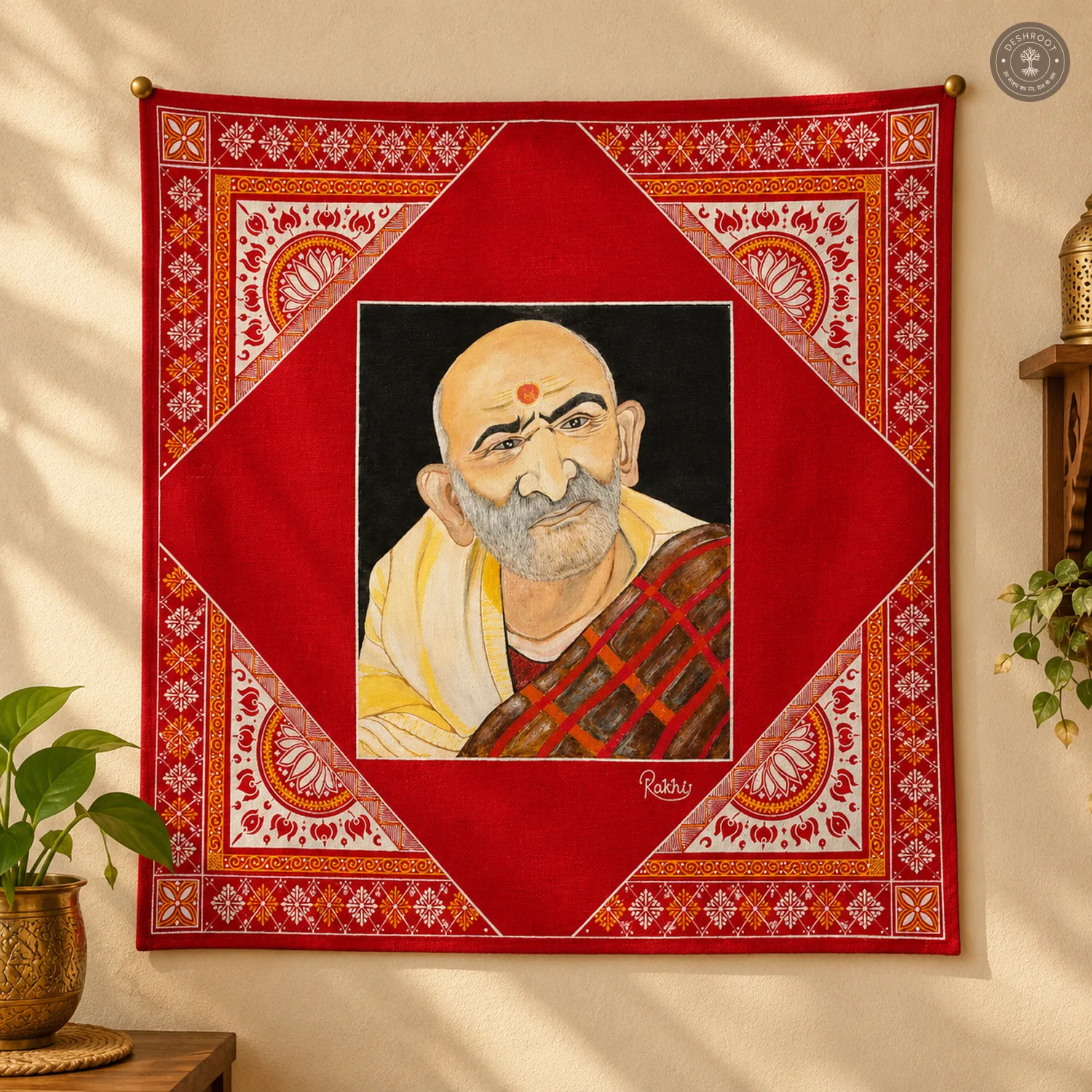
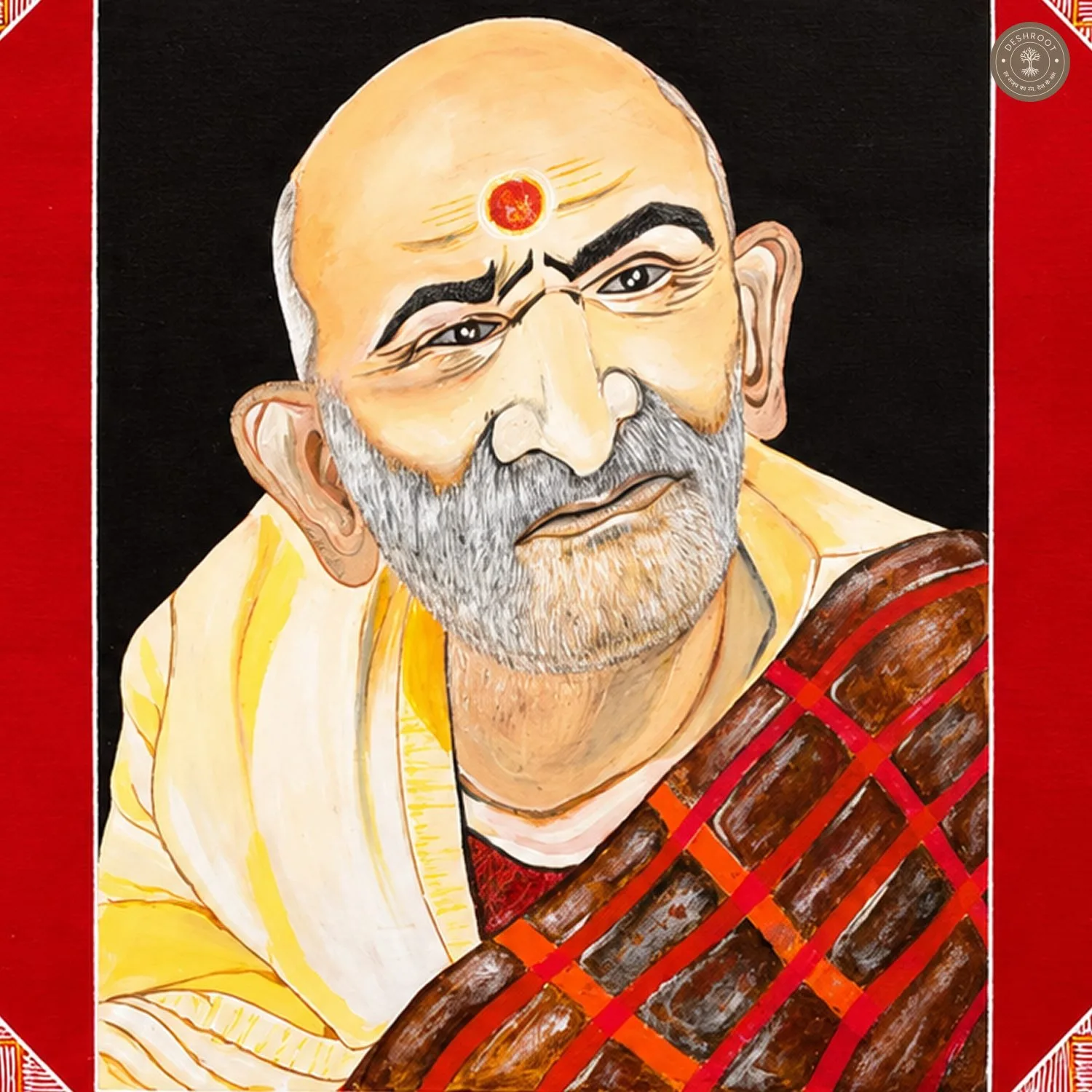
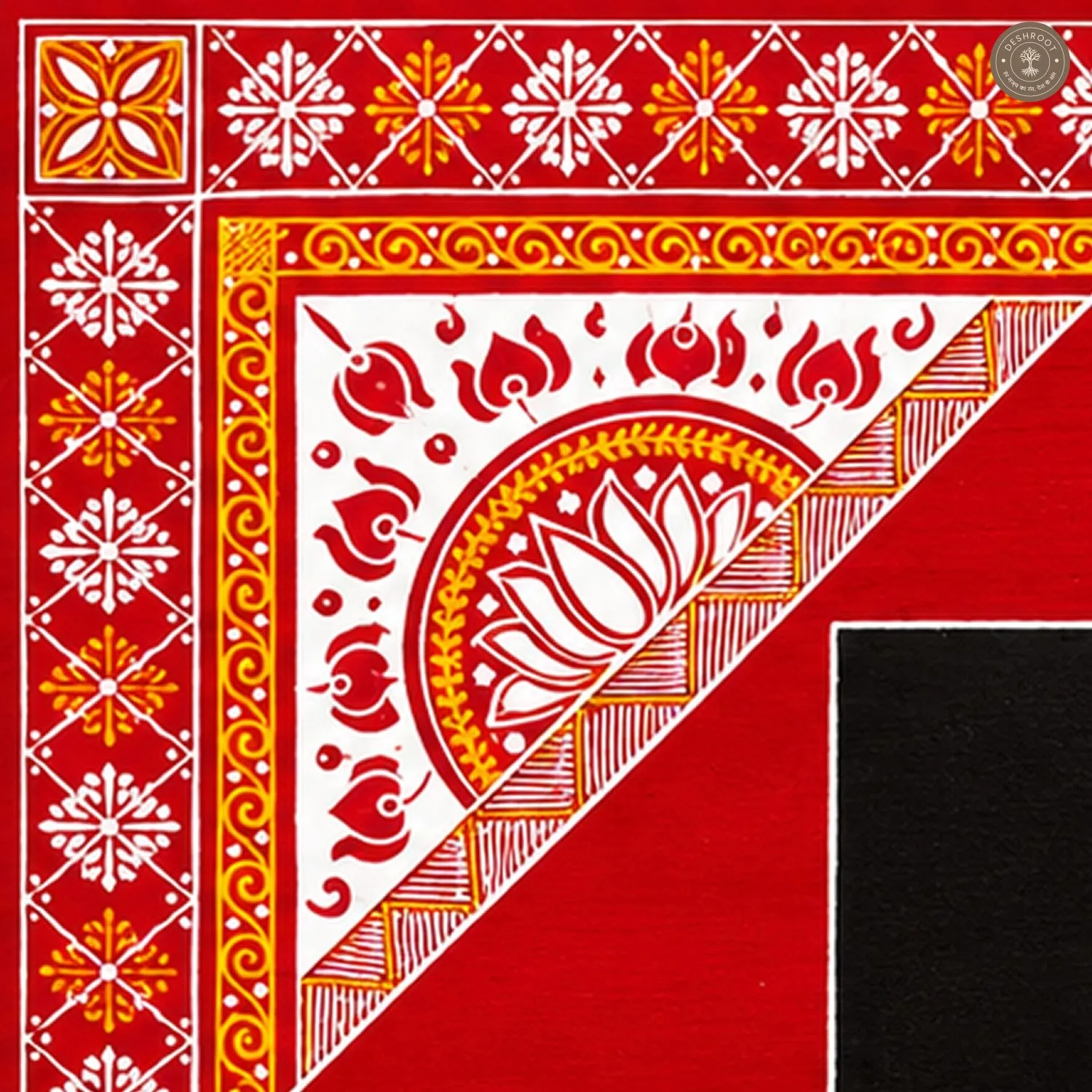
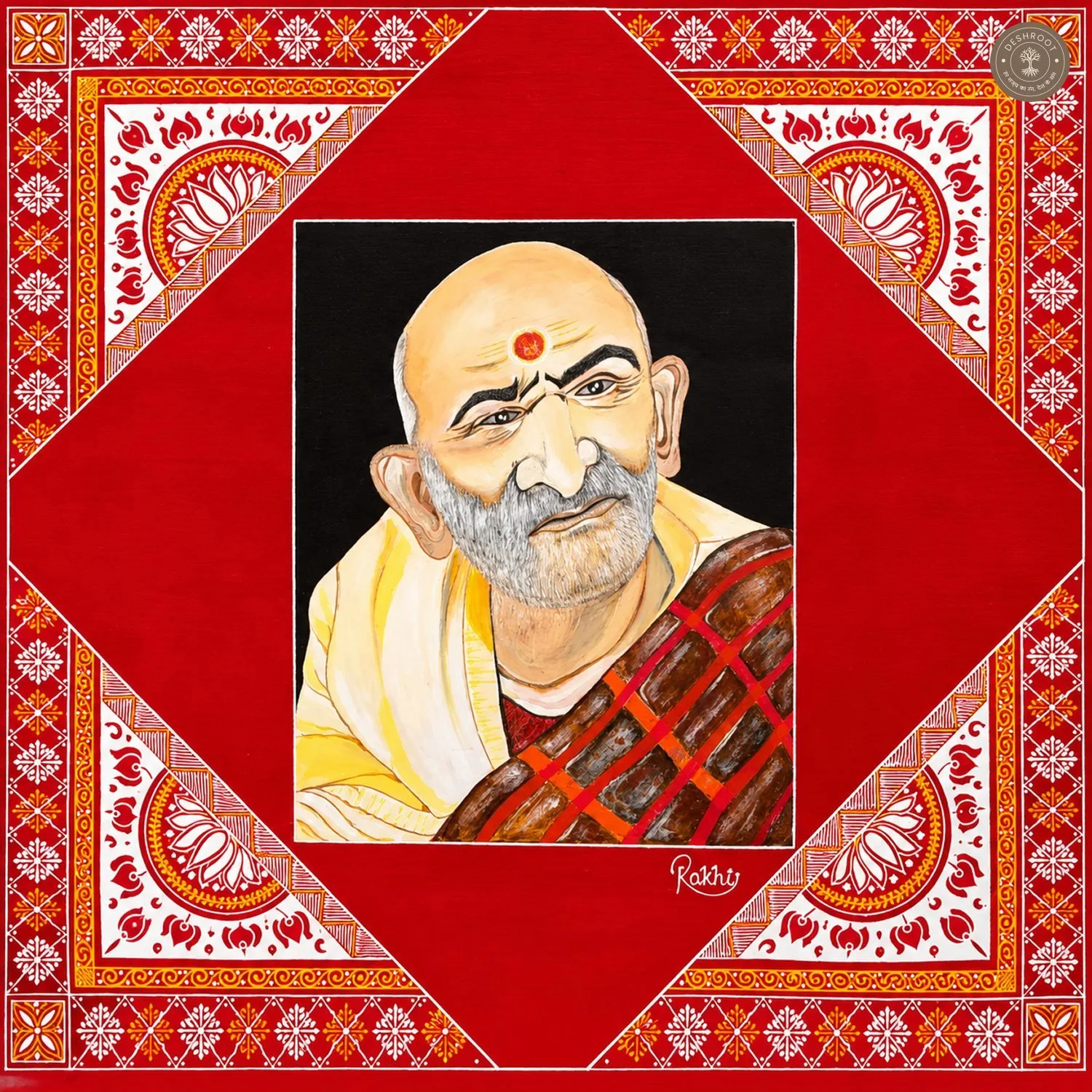
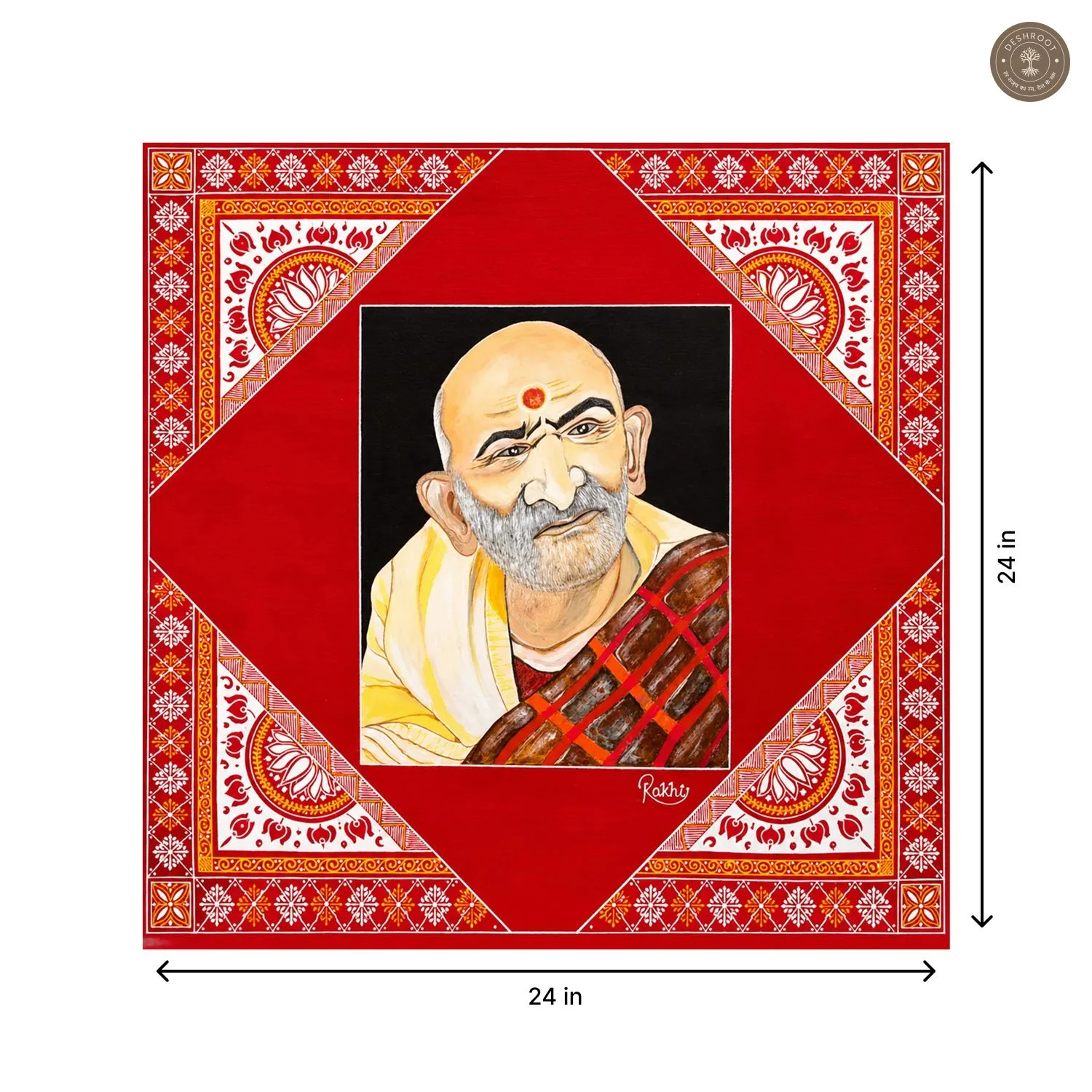
Aipanart Baba Neem Karoli Maharaj brings the traditional Aipan folk art of India to a portrait of one of the most loved saints of Uttarakhand. The portrait is done in acrylic colors on cloth and set in the center of a red cloth. Lotus motifs fill the corners, and a fine floral and geometric border runs around the edges. The cloth measures 26 x 26 inches, with a 24 x 24 inch artwork area.
About Baba Neem Karoli Maharaj
Neem Karoli Baba, also spelled Neeb Karori Baba and lovingly called Maharajji, lived from 1900 to 11 September 1973. He is counted among the greatest saints of the twentieth century. He was born in the village of Akbarpur in Firozabad district, Uttar Pradesh, about 1 kilometer from Hirangaon. His Samadhi Mandir is in Vrindavan.
Kainchi Dham in Nainital is on the left side of Bhuwaligad, 7 km from Bhuwali. Its annual festival takes place on June 15 each year, when a very large number of devotees gather there.
His Life
Maharajji was born into a wealthy merchant family. When his parents arranged his marriage at the age of 11, he left home to become a monk. Later, at his father’s request, he came back to live as a householder and became the father of two sons and a daughter.
It is believed that by the age of 17 he already held deep spiritual knowledge, and it is said that Lord Hanuman was his guru. He traveled across India and was known by different names in different states. At the Maa Tara Tarini Shakti Peetha in Ganjam, the locals called him Hanumanji, or Miracle Baba.
How He Got the Name Neem Karoli
The story goes that Baba was once traveling by train without a ticket. A ticket officer made him get off at the next station, which was called Neem Karoli. When the train was ordered to leave, it would not move, however hard the driver tried. Baba sat down nearby with his tongs, and everyone on board took it as a sign of his displeasure.
A senior officer who knew Baba apologized and asked the driver and the ticket officer to do the same. Baba agreed to board again, on the condition that a station be built there for the villagers, who had to travel long distances to catch a train. The promise was kept, and a station named Neem Karoli was built. From then on, his miracles became widely known, and he came to be called Neem Karoli Baba all over the world.
Education
Children from his birthplace used to go to the primary school in Hirangaon. There is now a school in Akbarpur as well.
His Ashrams
In India, his ashrams are at Kainchi, Bhumiyadhar, Kakrighat, and Hanumangarhi in the Kumaon Hills, and in Vrindavan, Rishikesh, Lucknow, Shimla, and Delhi. There is also one in the village of Neem Karoli near Khimasepur in Farrukhabad. Outside India, his ashram is in Taos, New Mexico, in the United States.
Notable Disciples and Devotees
His well-known disciples include spiritual teacher Ram Dass (author of Be Here Now), singer and teacher Bhagwan Das, meditation teacher Lama Surya Das, and the musicians Jai Uttal and Krishna Das.
Other devotees include humanitarian and spiritual activist Rahul Verma, humanitarian Larry Brilliant and his wife Girija, Dada Mukherjee (a former professor at Allahabad University), author Yvette Rosser, spiritual teacher Ma Jaya Sati Bhagavati, filmmaker John Bush, and Daniel Goleman, author of The Varieties of Meditative Experience and Emotional Intelligence.
Baba Hari Dass (Haridas) was not a disciple, but he looked after several buildings and ashrams in the Nainital area from 1954 to 1968. In early 1971, he moved to the United States and became a spiritual teacher in California.
Steve Jobs traveled to India in April 1974 with his friend Dan Kottke to study Hinduism and Indian spirituality. He also planned to meet Neem Karoli Baba, but learned on arrival that the saint had passed away the previous September. Actress Julia Roberts is also said to have been drawn to Hinduism by a photograph of him. Mark Zuckerberg, inspired by Steve Jobs, visited his ashram at Kainchi. Larry Brilliant also took Google’s Larry Page and eBay co-founder Jeffrey Skoll there.
Aipanart is a platform that showcases the traditional Aipan art of India and works to preserve this cultural heritage. Each design is crafted to support local artisans, encourage cultural exchange, and inspire a new generation to value the beauty and meaning of this ancient art form.
The cow’s life is the light of the earth. Save Cow, Save Culture, Save Nature.
|